APIs
An API in Faustine is what Faustine knows about one of your backends: its operations, their request and response schemas, and how it authenticates. Faustine builds it by analyzing your code, a spec or the running service. You manage it in the portal under APIs, and a gateway serves it to AI clients.
How it works
You create an API by pointing Faustine at the code: a repository, a ZIP, or for GraphQL and gRPC the live service or its schema files. The analysis reads it and writes the contract into the API's draft. You review the operations, publish a version, add a connection that says where the backend runs, and add the API to a gateway.
An API does not hold a URL or a credential. Those belong to its connections, one for each place the backend runs. The same contract therefore serves Staging and Production, and several gateways can serve the same API.
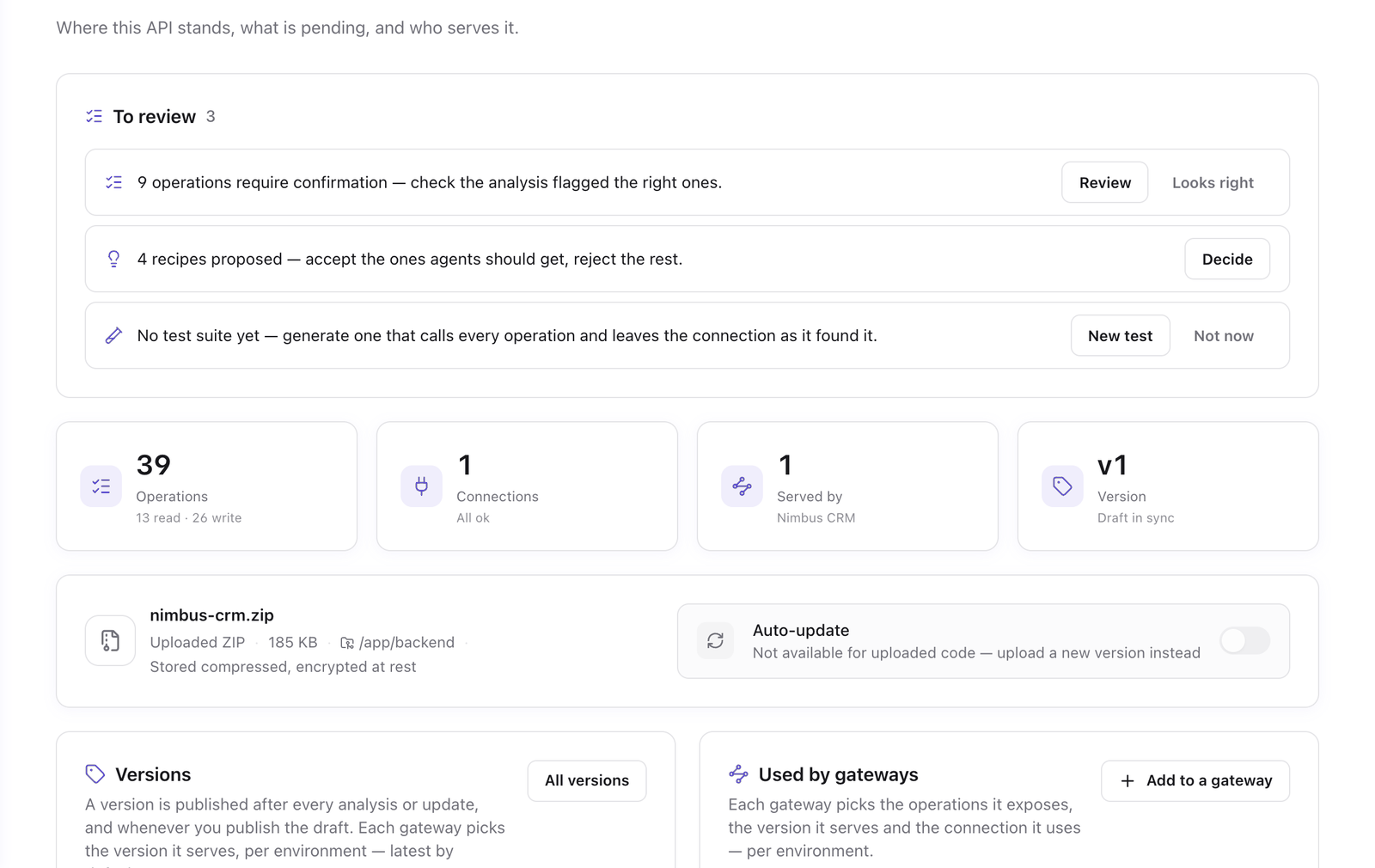
The parts of an API
Each part is a tab of the API page.
| Tab | What it holds |
|---|---|
| Overview | The setup steps that are still pending, a To review list, and the gateways that serve the API. |
| Operations | Every call an agent can make, with its kind and whether it requires confirmation. See Operations. |
| Recipes | Operations that make several calls in one step. See Recipes. |
| Tests | Generated suites that call the operations against a connection. See Generate and run API tests. |
| Connections | Where the backend runs and the credential values Faustine uses. See Connections. |
| Authentication | How Faustine signs in to the backend, set once for every connection. See Authentication. |
| Services | The services a REST API is made of. See Analyze an API made of several services. |
| Versions | Every published version and what changed in it. See Versions and updates. |
| Activity | What Faustine did with the API: analyses, updates, edits and tests. |
| Settings | Name, description, code source, analysis notes and deletion. |
Protocols
Faustine analyzes and serves REST, GraphQL and gRPC APIs. The protocol decides what an operation is and where the contract can come from.
| Protocol | An operation is | The contract comes from |
|---|---|---|
| REST | A route: a method and a path | The code, with an OpenAPI or Swagger file as an optional shortcut |
| GraphQL | A query or a mutation | Introspection of the live endpoint, an SDL or introspection JSON file, or the repository |
| gRPC | A unary method of a service | Server reflection, .proto files, or the repository |
Namespace and operation keys
Every API has a namespace, a short name made of lowercase letters and digits such as crm. Every operation has a key under it, such as crm.deals.create. Agents call operations by key in every gateway that serves the API.
You choose the namespace when you create the API. It cannot be changed afterwards.
Draft and versions
The analysis and your own edits go into the API's draft. Publish freezes the draft as a numbered version. Gateways serve published versions and never the draft, so an edit reaches agents only after you publish. See Versions and updates.
From an API to an agent
An API serves nothing until three things exist:
- An analysis that finished. See Create an API.
- A connection. See Add a connection.
- A gateway that includes the API. See Add an API to a gateway.
The Overview tab shows these three steps under Set up this API and marks each one when it is done.
Next steps
- Analyze your first API: go from a repository to tested operations on the example app.
- Create an API: the steps of the New API wizard for a REST API.
- The analysis: what Faustine reads and what it writes.
- Operations: what each operation carries and what you can change.
- Agent Gateway: serve the API to AI clients.
Last updated November 11, 2026